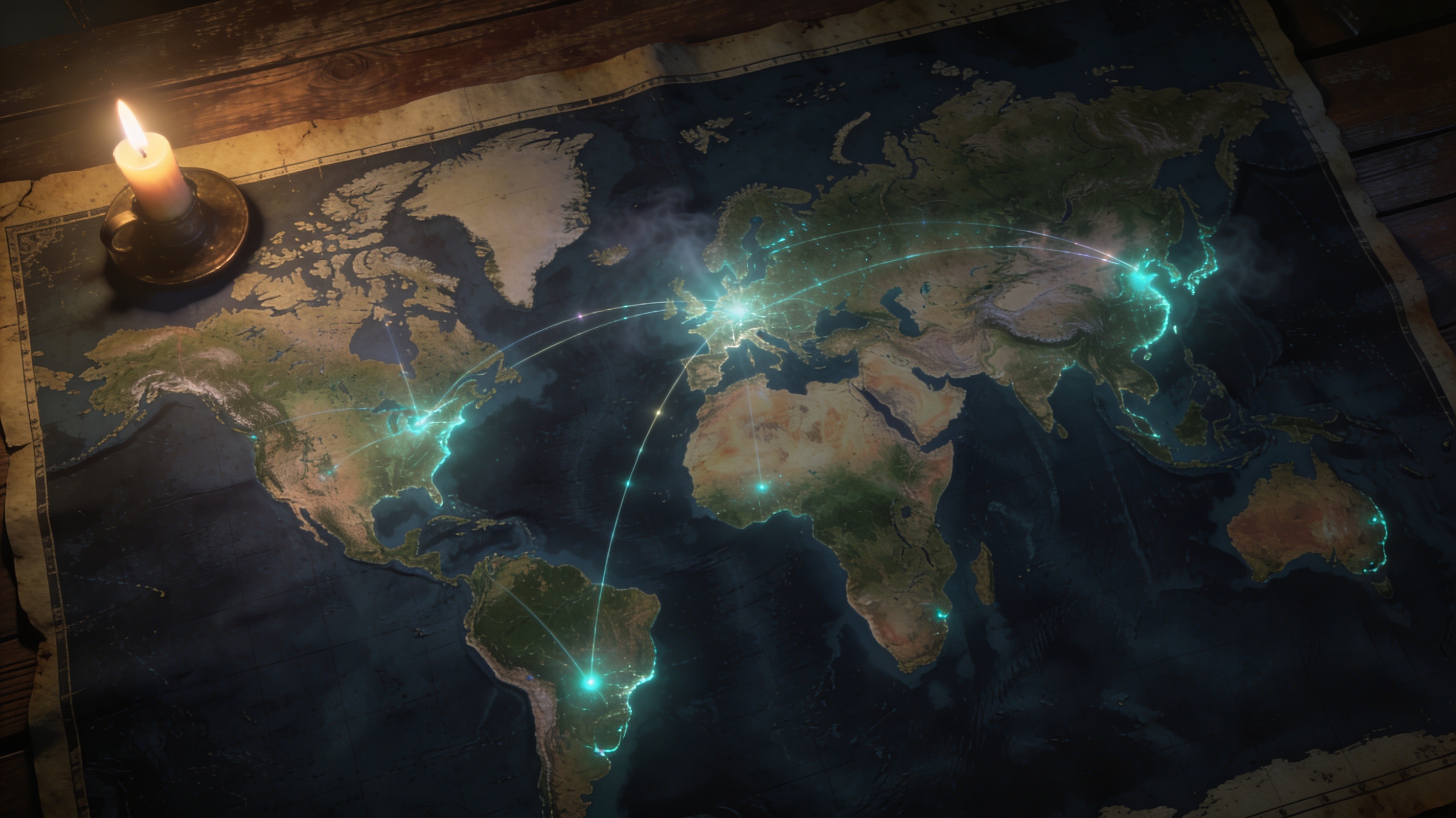
Antique world map with glowing strategic lines, representing geopolitical war theories
SiaTechHub War Room · War Theories

The Theories That
Shape Every War

Most people have no idea that today's conflicts — from Ukraine to the Strait of Hormuz — are being played out according to ideas written over a century ago. This is your guide.

~15 min read Updated April 2026 5 Theories Explained

Why These Theories Still Rule the World

When you watch the news — Russia grinding forward in Ukraine, the US blockading Iran's ports, China patrolling the South China Sea — it can look like random chaos. It isn't. Beneath every headline is a logic that geopolitical strategists figured out between 1890 and 1950: that geography determines power, and that whoever controls the right pieces of the map controls the world.

These theories aren't museum pieces. They are the operating manuals of every major military and foreign policy establishment on Earth. American generals study Mahan. Russian doctrine is built on Mackinder. China's Belt and Road is Spykman reborn. Trump's Venezuela move is Monroe dressed in MAGA clothes.

The five frameworks in this guide — Heartland, Rimland, Sea Power, Monroe Doctrine, and Strategic Chaos — are the lens through which every major power actually sees the world. Learn them once, and you'll never watch the news the same way again.

"Who rules East Europe commands the Heartland; who rules the Heartland commands the World-Island; who rules the World-Island commands the World."
— Halford John Mackinder, 1919
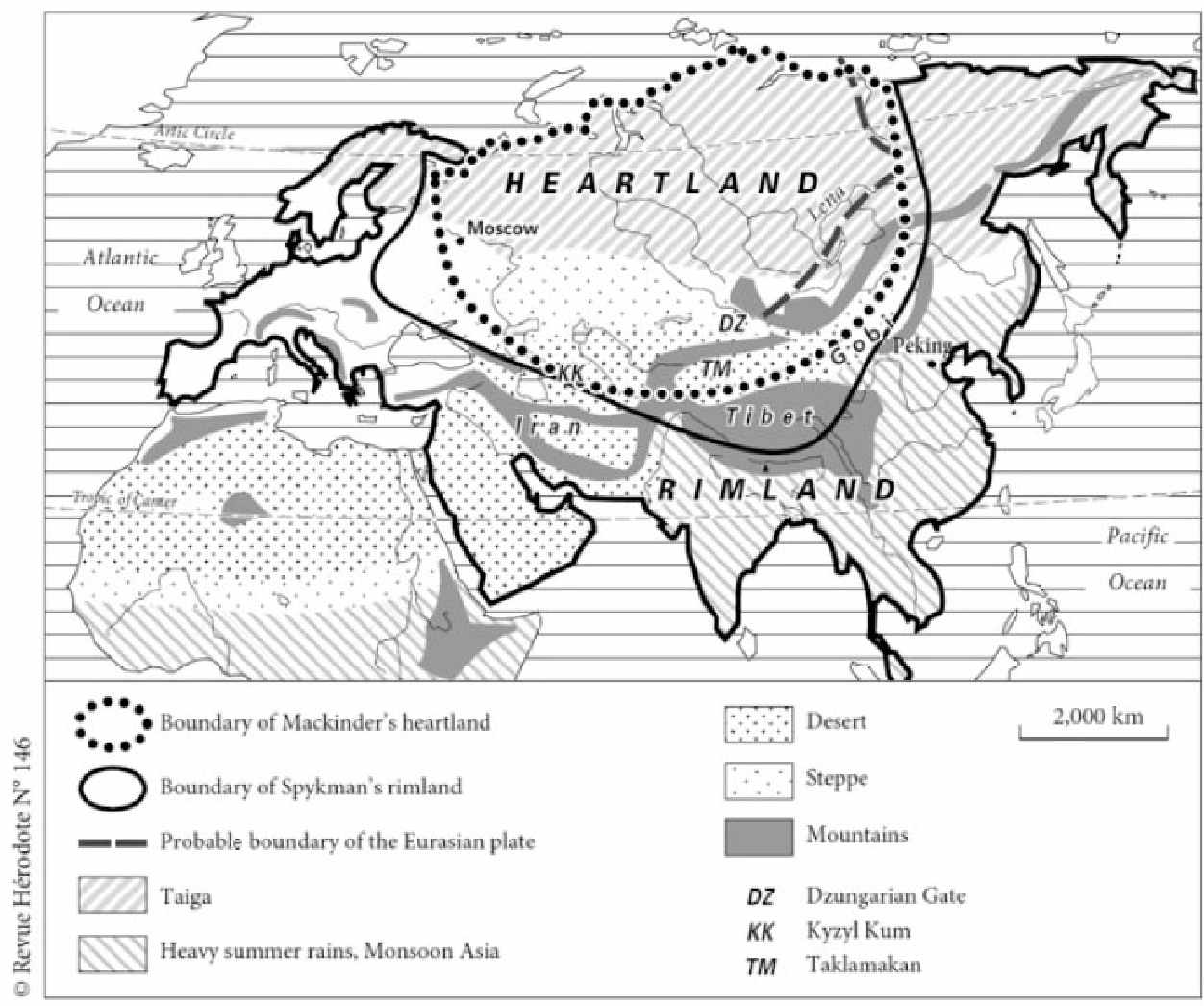
Map of Mackinder's Heartland theory showing Heartland, Rimland and World Island regions

Mackinder's classic 1904 Heartland map — the foundation of modern geopolitical theory

The Five Theories
01
Land Power

The Heartland Theory

Halford John Mackinder, 1904 — "Dominate the interior of Eurasia, and you dominate the world."

British geographer Halford Mackinder looked at a world map in 1904 and made a startling claim: the most strategically important place on Earth was not an ocean or a coastline — it was a vast, landlocked region stretching from Eastern Europe through Central Asia into Siberia. He called it the Heartland, or the "Pivot Area."

His reasoning was simple but powerful. The Heartland is so large, so resource-rich, and so geographically insulated that any power controlling it would be nearly impossible to attack. Surrounded by deserts, mountains, and frozen seas, it was beyond the reach of the naval forces that had dominated global power for centuries. A land empire there would have unlimited resources and strategic depth — no navy could touch it.

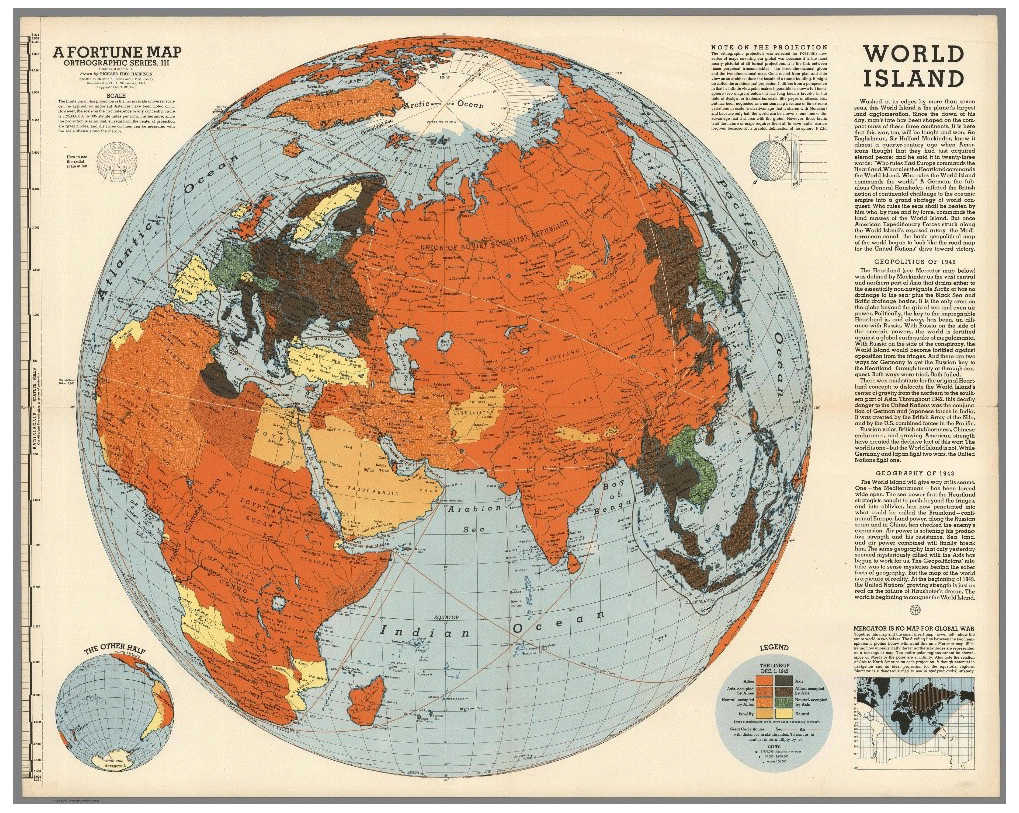
Mackinder framed his entire theory around a famous hierarchy: the Heartland sits at the center of the World-Island (Eurasia + Africa — the largest, most populous landmass on Earth). Control the Heartland, and you control the World-Island. Control the World-Island, and you control the globe.

Today, this is Russia and China's playbook. Russia sits in and guards the Heartland. China is building economic and physical infrastructure across it — the Belt and Road Initiative is essentially an attempt to make the Heartland economically unified under Chinese influence for the first time in history.

Core Principles
  • Geographic insularity = strategic invulnerability. No navy can reach the interior.
  • The Heartland has enormous natural resources and manpower potential.
  • Any power unifying Eurasia under one roof becomes an unstoppable superpower.
  • The West's primary strategic goal must be to prevent Heartland unification.
In the World Today · April 2026

Russia's invasion of Ukraine is a Heartland move — keeping the strategic buffer zone under Moscow's sphere. China's Belt and Road Initiative is building roads, railways and ports through Central Asia, effectively trying to "activate" the Heartland economically for the first time. The Russia-China partnership is precisely the kind of unified Heartland power that Mackinder warned the West must never allow.
Theorist
Halford Mackinder
British geographer, 1861–1947
Published
1904 / 1919
"The Geographical Pivot of History"
Modern Players
Russia + China
Pursuing Heartland dominance
Vintage world map highlighting Mackinder's Heartland World Island theory 1919
Mackinder's 1919 "World Island" map showing the Heartland pivot region at the center of Eurasia
02
Buffer Strategy

The Rimland Theory

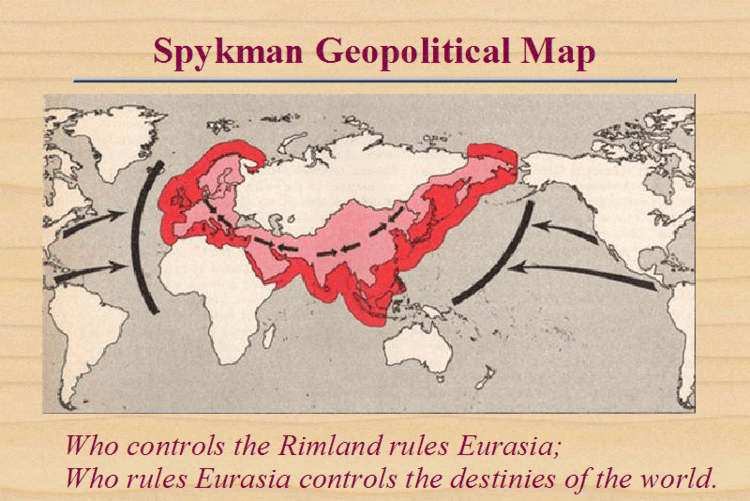
Nicholas Spykman, 1942 — "Who controls the Rimland rules Eurasia; who rules Eurasia controls the destinies of the world."

Yale professor Nicholas Spykman read Mackinder and disagreed with the emphasis. Yes, the Heartland was important — but the Rimland was the real prize. The Rimland is the crescent of coastal land that wraps around Eurasia: Western Europe, the Middle East, South Asia, and East Asia. It's the zone between the Heartland and the outer seas.

Spykman argued that the Rimland was both more productive and more strategically decisive than the Heartland. It contained the largest population centers, most of the world's industry, and the world's key ports. Crucially, the Rimland was the battleground between sea power and land power — whoever controlled it determined whether the Heartland could break out to the seas, or whether naval powers could contain the interior.

This theory became the direct intellectual foundation of US Cold War policy. Containment — the strategy of surrounding the Soviet Union with allied nations — is Spykman in action. NATO was built to hold Western Europe's Rimland. US alliances in Japan, South Korea, and Taiwan hold the Pacific Rimland. The entire American alliance system is a Rimland strategy.

Today, Europe's rapid militarization — forced by Trump's withdrawal of US security guarantees — is the Rimland trying to hold itself together without its traditional sea power patron. And China's pressure on Taiwan is an attempt to break through the Pacific Rimland and reach the open ocean.

Core Principles
  • The Rimland — Eurasia's coastal crescent — is more powerful than the Heartland.
  • Whoever holds the Rimland controls access between land and sea.
  • The US must maintain allied networks across the Rimland to contain interior powers.
  • The Rimland is the natural arena where all great power competition plays out.
In the World Today · April 2026

Europe is being forced to become a self-sustaining Rimland buffer — the US is shifting its security burden onto European allies to free up resources for the Pacific. NATO's Eastern flank (Poland, the Baltics, Romania) is the hottest Rimland real estate on the planet right now. Meanwhile, China-Taiwan represents the critical Pacific Rimland chokepoint — if Taiwan falls, China exits the Rimland and becomes a Pacific power.

Spykman Rimland map with quote: Who controls the Rimland rules Eurasia
Spykman's Rimland map — the red zone is the most strategically contested land on Earth
03
Naval Power

Mahan's Sea Power Theory

Alfred Thayer Mahan, 1890 — "Control the seas, control the world's commerce, control world power."

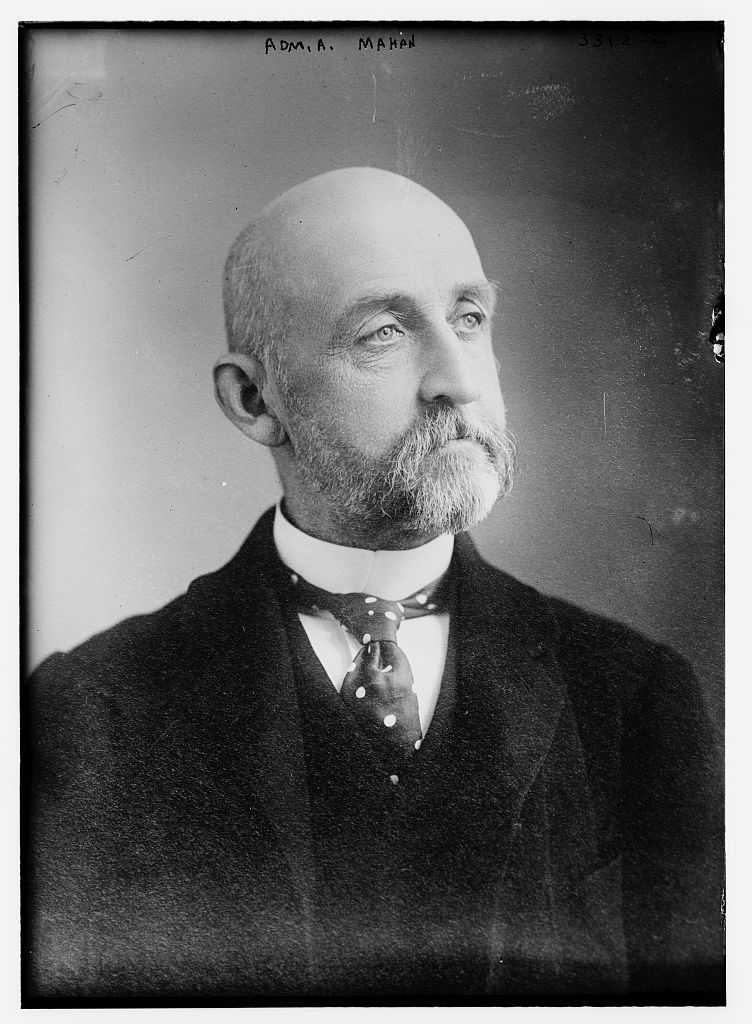
American admiral Alfred Thayer Mahan published The Influence of Sea Power upon History in 1890 and changed the world. His argument was elegantly simple: throughout history, the most powerful nations have always been the ones that controlled the seas. Rome declined when it lost naval supremacy. Britain built its empire on maritime dominance. The US would need a powerful navy to become a great power.

Mahan identified three keys to sea power: naval force (a strong blue-water navy capable of projecting power far from home), merchant fleet (commercial shipping that generates wealth and can be converted to military use), and strategic bases (ports and coaling stations at key geographic chokepoints around the world). Miss any one of these three, and your sea power collapses.

The critical chokepoints in Mahan's theory are the narrow passages through which all ocean trade must flow: the Strait of Hormuz (Persian Gulf oil), the Strait of Malacca (China's oil supply), the Suez Canal (Europe-Asia trade), the Panama Canal (Atlantic-Pacific), and the Strait of Gibraltar. Control these, and you control the global economy's jugular.

Mahan's theory was so influential it triggered a global naval arms race before World War I. Today it drives the US Navy's carrier strike group strategy, China's artificial island bases in the South China Sea, and — most visibly right now — the entire US-Iran conflict over the Strait of Hormuz.

Core Principles
  • Naval supremacy equals economic and strategic supremacy. Whoever rules the seas rules trade.
  • Strategic chokepoints (straits, canals) are more valuable than any individual territory.
  • A nation needs naval bases around the world to maintain a credible global force.
  • Naval power projection is both a military and a commercial instrument.
In the World Today · April 2026

The US-Iran war is the most pure Mahanian conflict of our era. Everything pivots on the Strait of Hormuz — the 21-mile wide passage through which 20% of the world's oil flows. The US initiated a naval blockade of Iranian ports in April 2026. Iran's entire strategic leverage is the credible threat to close this chokepoint. China's South China Sea islands are naval bases for Mahan-style Pacific power projection.

Portrait of Rear Admiral Alfred Thayer Mahan, naval theorist
Rear Admiral Alfred Thayer Mahan (1840–1914) — his 1890 book changed the course of naval strategy and great-power competition
04
Hemispheric Dominance

The Monroe Doctrine

President James Monroe, 1823 — "The Western Hemisphere is off-limits to European colonialism — it belongs to America's sphere."

In 1823, US President James Monroe declared a principle that would define American foreign policy for two centuries: the Western Hemisphere was the United States' backyard, and any European power that tried to colonize or interfere there would be treated as a hostile act against the US itself. At the time, it was a bluff — the US barely had a navy. Within a century, it became the law of the hemisphere.

The Monroe Doctrine is essentially a regional Mahan strategy. The US doesn't need to project power globally if it can dominate its own hemisphere — the Western Hemisphere gives the US a secure resource base, strategic depth, and Caribbean sea lane control without risking land wars in Eurasia. Theodore Roosevelt later extended it aggressively: not only would the US prevent Europeans from interfering, it would directly intervene in Latin American countries to enforce order and protect American interests.

The doctrine went through periods of dormancy — especially during the Cold War's global commitments — but it never died. Trump revived it explicitly in his second term. When the US captured Venezuelan President Maduro in January 2026, it was the most naked Monroe Doctrine enforcement in modern history: America telling the world it will directly run a Latin American country to deny it to Chinese and Russian influence.

Core Principles
  • The Western Hemisphere is America's exclusive sphere of influence.
  • No outside power may colonize or establish new political influence in the Americas.
  • The US reserves the right to intervene unilaterally to enforce regional order.
  • Hemisphere control frees the US to project power globally from a secure base.
In the World Today · April 2026

Trump's capture of Venezuelan President Maduro in January 2026, and the US announcement it would administer Venezuela until elections, is Monroe Doctrine in its most explicit modern form. The US also claims Greenland under Monroe-like logic — keeping Arctic and Atlantic approaches under American control. This is the US saying: while we fight Iran (Mahan) and manage Europe's Russia problem (Rimland), we are securing our own hemisphere first.

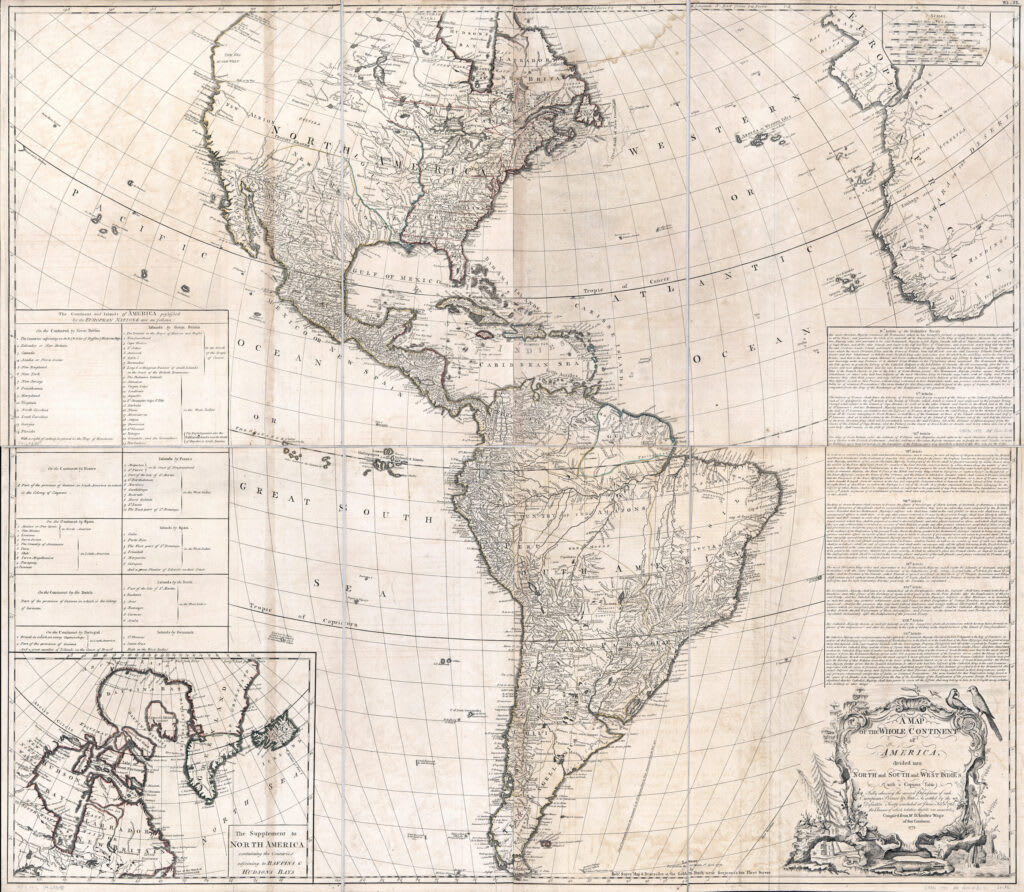
Vintage engraved map of the Western Hemisphere representing the Monroe Doctrine
The Western Hemisphere — the Monroe Doctrine's declared sphere of influence since 1823
05
Hybrid Warfare

Strategic Chaos Theory

Modern doctrine — "Don't fight to win territory. Fight to keep your enemy too confused, divided, and exhausted to threaten you."

The four classical theories all assume the same thing: a rational great power trying to secure and hold geographic territory. Strategic Chaos Theory turns that logic inside out. Instead of trying to build a coherent order, some actors deliberately manufacture and sustain disorder as their primary tool of power. The goal is not conquest — it's paralysis.

This is not purely a modern idea. The concept of using instability as a weapon has ancient roots. But in the 20th and 21st centuries it became a systematized strategy, particularly associated with hybrid warfare: a combination of conventional military pressure, covert operations, information warfare, economic manipulation, and support for proxy militias — all calibrated to keep target countries weak, divided, and unable to consolidate against you.

The theory's core logic: chaos is asymmetric. Creating disorder is far cheaper than the cost to the defender of managing it. A small investment in destabilization — funding extremist groups, flooding social media with disinformation, assassinating key figures, blocking economic development — can tie down vastly larger adversaries indefinitely. The classic Western powers' preference for stability and rule-of-law actually makes them more vulnerable to chaos strategies.

Russia has been the most systematic practitioner: interference in Western elections, the Wagner Group operating across Africa, support for separatist movements from Eastern Ukraine to the Sahel. But all major powers use elements of chaos doctrine. The US used it in Cold War Latin America. China uses it in information warfare operations across Southeast Asia.

Core Principles
  • Sustained instability in an adversary's territory is more cost-effective than conquest.
  • Chaos is asymmetric — cheap to create, expensive to contain.
  • Proxy forces, information warfare, and economic sabotage are the primary tools.
  • The goal is permanent exhaustion and division, not territorial acquisition.
In the World Today · April 2026

The Iran war has spiked global oil prices — a windfall for Russia even while its forces underperform in Ukraine. That's chaos theory generating profit. Over 20 active armed conflicts are running across four continents simultaneously, draining Western attention, humanitarian resources, and political will. Sudan, Congo, Myanmar, Yemen — these "forgotten wars" are the chaos substrate: zones of permanent instability that prevent any single power from building a clean strategic order.

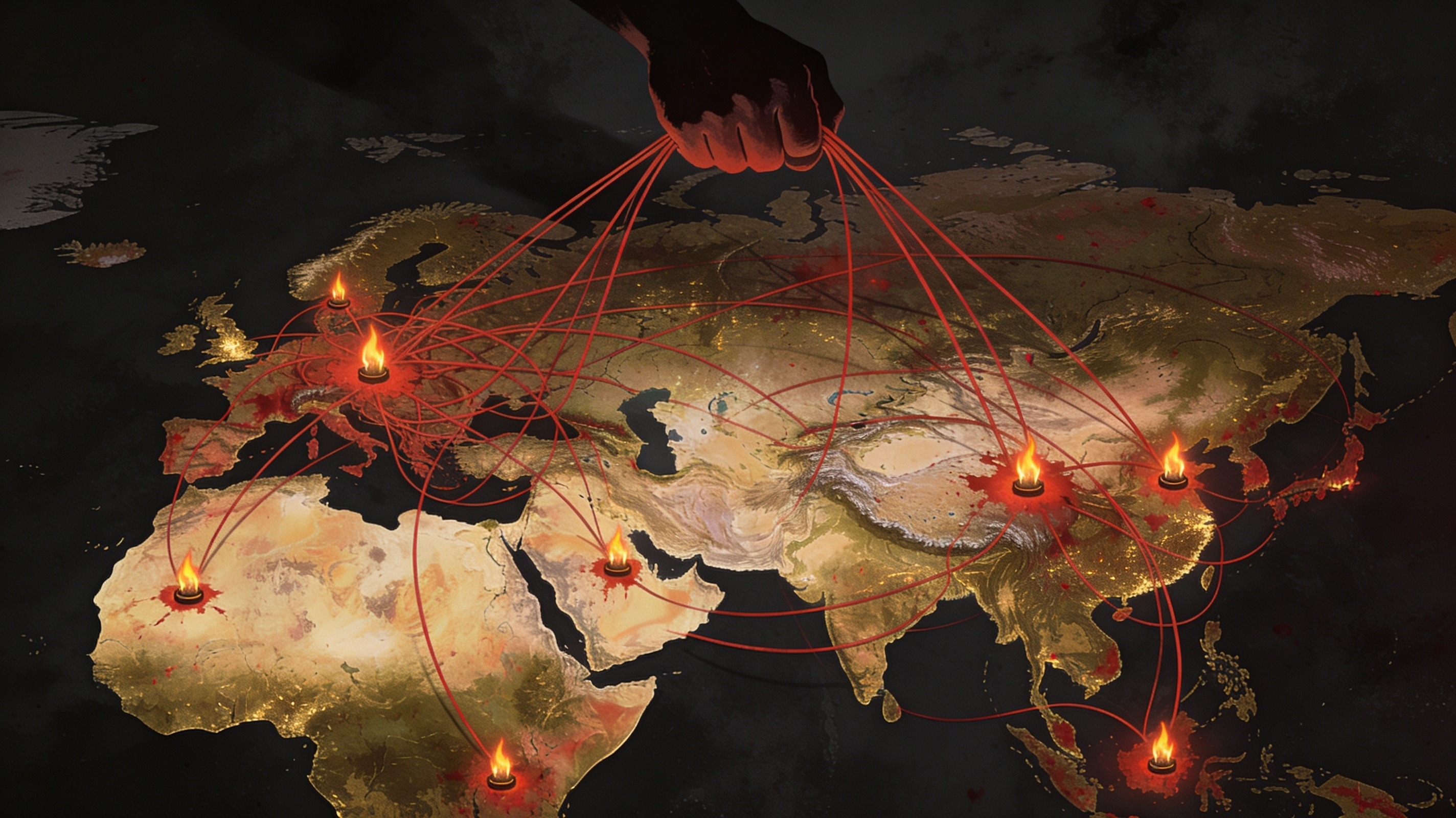
Strategic chaos theory illustration: tangled conflict zones across a global map with an invisible hand
Strategic chaos in action — multiple simultaneous conflicts, proxy networks, and disinformation campaigns keeping adversaries permanently off-balance
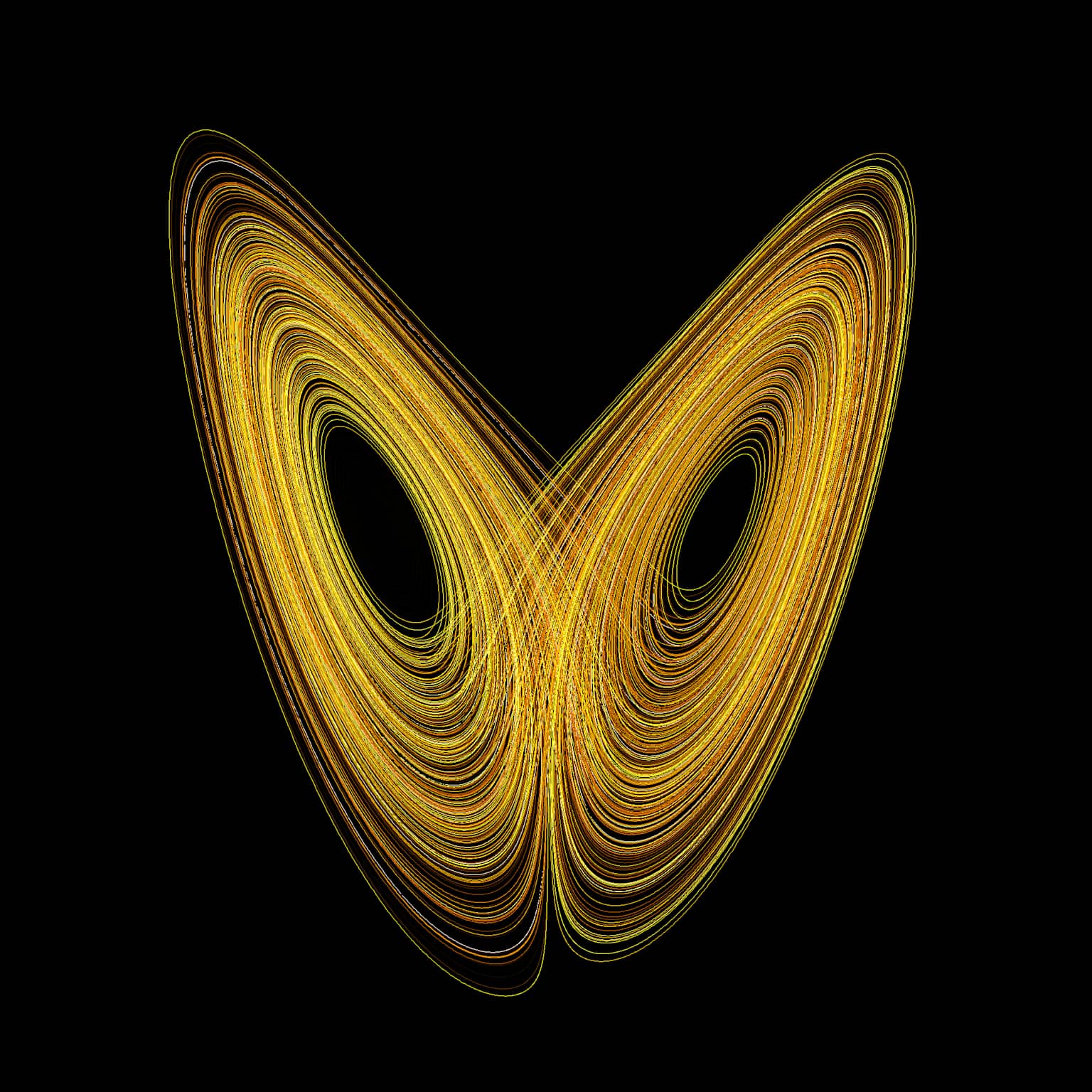
Golden butterfly chaos attractor — mathematical visualization of chaos theory
The Lorenz Attractor — chaos theory's most famous mathematical visualization. Small inputs, wildly unpredictable outputs. The metaphor for modern geopolitics.
Side by Side

Five Theories at a Glance

Each theory answers the same question — "what is the source of national power?" — from a radically different angle. None is completely right. None is completely wrong. The world in 2026 is running all five simultaneously.

Theory Theorist Core Claim Primary Domain Key Strategy 2026 Practitioner
Heartland Mackinder (1904) Control Eurasia's interior core Land / Interior Secure and unify the Heartland against coastal encirclement Russia + China
Rimland Spykman (1942) Hold Eurasia's coastal crescent Land-Sea buffer Alliance networks across the Rimland to contain interior powers NATO / EU / US alliances
Sea Power Mahan (1890) Control the oceans and chokepoints Maritime / Naval Blue-water navy + strategic bases at every chokepoint USA (Hormuz) / China (S. China Sea)
Monroe Doctrine Monroe (1823) Dominate the Western Hemisphere Regional sphere Exclude rivals from the Americas; intervene unilaterally if needed USA (Venezuela, Greenland)
Strategic Chaos Modern hybrid warfare Weaponize disorder itself All domains Proxies, disinformation, economic sabotage — keep adversaries permanently off-balance Russia (global); all major powers
April 2026

All Five Theories. Right Now.

The world in 2026 isn't running one geopolitical theory — it's running all five at once, on different stages. Here's where each is playing out in real time.

🗺️ Heartland in Action

Ukraine & the Russia-China Axis

Russia continues grinding toward Huliaipole in year four of the war. China deepens its "comprehensive strategic partnership" with Moscow. The Eurasian Heartland is being slowly consolidated under a dual-power axis. This is Mackinder's nightmare scenario.

Heartland Theory
🛡️ Rimland Under Pressure

Europe Militarizing Without the US

With the US shifting security burden to European allies to free up resources for the Pacific, NATO's Eastern flank is arming at historic speed. Europe is becoming what Lavrov called a "primary frontline bloc" — the Rimland trying to hold itself without its patron.

Rimland Theory
⚓ Sea Power at War

The Strait of Hormuz Conflict

The US-Iran war launched February 28, 2026 is the most Mahanian event of our era. US naval blockade of Iranian ports in April. Iran's leverage is closing the Strait. 20% of the world's oil flows through a 21-mile bottleneck. Chokepoint control is everything.

Mahan Sea Power
🦅 Monroe Revived

Venezuela & the Americas First

The US captured President Maduro in January 2026 and announced it would administer Venezuela until elections. Trump also claims Greenland. The Monroe Doctrine hasn't just been revived — it's being enforced with military force for the first time in a century.

Monroe Doctrine
🌀 Chaos Everywhere

20+ Wars, Zero Resolution

More than 20 active armed conflicts run simultaneously across four continents. Sudan, Congo, Myanmar, Yemen grind on. Russia profits from oil price spikes caused by the Iran war. The IMF projects global growth slowing to 3.1%. No single power can build a clean order.

Strategic Chaos
🌏 The Next Act

China-Taiwan: The Fuse Not Yet Lit

EU risk analysts have upgraded China-Taiwan from Medium to High risk. If it ignites, it triggers Rimland (Taiwan), Mahan (Pacific chokepoints), Monroe (US Pacific commitment vs. Latin America), and Chaos (all at once). The biggest test of all five theories together.

All Theories Converge